In wikis that are configured for AI-usage, an AI summary can be displayed before the results list. This display is controlled via the [[Manual:Extension/BlueSpiceConfigManager#ChatBot|configuration manager]] {{Bsvs|bsvFrom=5.2.2}}.
In wikis that are configured for AI-usage, an AI summary can be displayed before the results list. This display is controlled via the [[Manual:Extension/BlueSpiceConfigManager#ChatBot|configuration manager for extension ChatBot]] {{Bsvs|bsvFrom=5.2.2}}.
===Search operators===
===Search operators===
Revision as of 11:10, 26 February 2026
ExtendedSearch replaces the default MediaWiki search engine. It is based on the OpenSearch engine. Pages and files are indexed immediately and available for searching in real-time.
wiki pages: all wiki pages, except for pages in the MediaWiki namespace
special pages: all pages in the namespace Special
repo files: files uploaded to the wiki - for text files like Word documents and PDFs, this includes content and metadata
external files (if configured): files from arbitrary locations from accessible storage paths (e.g., mounted drives)
Search context
Users always need to be aware of the search context. If the search is started from any regular wiki page, the wiki searches for page titles only. If a user switches to the Search center, the results for the search term are based on a full-text search.
Difference between title search and full text search
Title search
Full-text search
Search scope
only the page titles are searched
content is also searched. This includes content on wiki pages and also content in files, for example PDFs or Word documents.
search results can be limted to pages in a book (in combination with other filters)
Quick search
Recently viewed
When you place the cursor in the search field, it returns a list of pages that you have found and accessed through a recent search. Any suggested pages that you are not interested in, you can remove from this view by clicking on the x to the right of the page name. Once you start typing, the default suggestions disappear.
Page suggestions for youbased on your recent searches
Title search
The most prominent search feature is the search box in the header of the wiki. If a user has not switched to the search center yet, this field simply looks for a page name or display title that contains the exact search term.
The title search does not do a full-text search. You have to switch to the full-text search (=Search center) for that. This can be done by simply pressing the Enter key after entering a search term in the search field.
How the title search works:
It is not case-sensitive: "qual" or "Qual" return the same results.
Search results are limited to 10 page titles. This is important to understand to have the right expectations. In most cases, the search field is simply used as a springboard to pages that are known to the user (e.g., to jump to a team page or to the page "Processes" or any other known page the user wants to reach quickly).
Spelling mistakes will usually not return any results: "Qality" does not return "Quality". Based on the version of your wiki, the search might return suggestions ("You might be looking for....").
Multiple search terms can be in any order to produce results ("toc download" finds pages just like "download toc").
Search operators such as "", OR, ANDre not supported. However, they are supported in the full-text search.
The sort order for the results are based on a combination of best title match and last edit date of the page. (You can find the technical details on the reference page for the extension ExtendedSearch. Some configuration changes are possible if the wiki is hosted on premise. There are no configuration options in Cloud wikis. )
The search offers a filter (screenshot annotation 1) to search:
in subpages of the page you are on (if it has subpages)
in the namespace of the page you are currently on
in the book of the page you are currently on (if you are in a book)
in the whole wiki
A search match shows the following information (screenshot annotation 2)
Page title
Below the page title, the namespace prefix of the page. If the result is a subpage, the subpage path is shown next to the namespace prefix.
If the title match is based on the display title of a page, the original title is shown in parentheses.
If the page is redirected to a different page, the redirect link is shown with a redirect-arrow in front of the target page title. If the target page has a display title, only the display title of the target page is shown. Otherwise the full path of the target page is shown.
The search bar supports pills for namespaces and subpages.
Namespace "pill"
If a user types Manual:and clicks "Enter", a pill for the namespace "Manual" appears and the search for the following term is limited to this namespace. .
Subpages
Subpage pills work in the same way. If you type in PageName/, any term after that is matched in the context of that page. If you search for "TestPage/Te", for example, the search will match only subpages of "TestPage" that contain "Te" in the title, like "TestPage/Test" and "TestPage/TestSubpage".
Subpages in namespaces are only found if the namespace prefix is included (assuming you are typing in the direct path to the subpage).
For example, the "Images" subpage with the path Manual:Extension/VisualEditor/Images is found when you type:
"Manual:Extension/Imag"
"Manual:VisualEditor/Imag"
"Manual:Imag"
The page is not found via:
"VisualEditor/Imag"
"Extension/Imag"
Dates as search terms
The search recognizes certain date formats. In the search center, these date formats are treated with surrounding quotation marks.
As soon as you trigger the full-search with the magnifying glass symbol or the Enter key, the wiki switches to the Search Center. This is a special page that offers the full functionality of the search. The search in the Search Center is carried out using the same search bar that is also used for autocomplete.
Here, the search engine carries out a full text search, which also includes the metadata of documents. It does not index the wikitext of a wiki page, but rather the rendered content, that is the output by the browser.
In wikis that are configured for AI-usage, an AI summary can be displayed before the results list. This display is controlled via the configuration manager for extension ChatBot v5.2.2+.
Search operators
Important!Search operators only work in the search center (fulltext search). You cannot use search operators in the title search.
If you are searching for contiguous words, they should be enclosed in quotation marks (") for performance reasons and to support a unique search.
Search operators have to be written in all-caps.
AND
admin AND docu: Returns pages that contain the exact termadminas well as the exact termdocu
admin* AND docu: If the term administration should be found, you need to provide a wildcard asterisk (*).
Compare: The search admin docu automatically is a wildcard search. It returns pages that contain bothadmin*anddocu* . This search normally finds more results than the serach admin* AND docu (because in the second case, the exact term docu is returned).
" (apostrophes)
Apostrophes around a search term triggers an AND search for all terms in the query:
"admin" docu: same result as admin AND docu (i.e., also the precise term docu will be searched).
NOT
admin* NOT docu*: Returns pages that contain words that start with admin , but that don't contain words that start with docu .
OR
admin OR docu: Returns pages that contain either the exact termadminor the exact termdocu.
* (wildcard)
admin*: Returns pages that contain words that begin with admin .
Elements
Hit count - shows how many matches a search has returned. It may be exact or approximate. Approximation is due to dynamic check for permissions to view each page in the results, some results may not be shown to the user with no adequate permissions event if it matches the search term.
Search actionsSearch actions
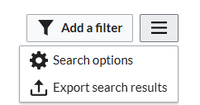
Add a filter - represented by a "funnel" icon - opens a dialog where users can select the filter type(s) that are applied to the search results.
Search options - represented by a "hamburger menu" icon - opens a dialog where users can change settings for the current search. It provides options like the number of results per page, sorting field and order.File:Manual:extendedsearch3.pngAdding filters
Export search - opens a dialog to export current search results to a dedicated page (only visible to authorized users, by default admin users).
Filter: Additional filters can be set from the filter button. Available filters vary based on BlueSpice version. Active filters can be removed by clicking on the "x" button in each filter pill.
In case there is an exact match for a given search term, the result that matches exactly is displayed as a "featured" result. Such a result displays a preview image of the page and always displays the content snippet, regardless of whether there are matches in the content or not.
Results relevance
All logged-in users can mark certain results as "favorites" by clicking on the pin symbol in the right corner of each result.
Files marked as "favorite" will score higher in future searches. This is not visible immediately, however, since a background process has to finish to update these preferences.
One user's pins won't affect other user's searches. Results can be unmarked as "favorite" by clicking on the "pin" symbol again.
Exporting search results
After executing the search, administrators can export (save) the results to a specific page using the "Export" command from the "Tools" menu. The list is exported to MediaWiki:PageCollection/LISTENNAME.
Only valid wikipages are exported. The exported pages can be added to a book via Mass add> Source: Page collection in the book's edit menu.
Configuration
In the BlueSpiceConfigManager, under settings for the extension BlueSpiceExtendedSearch, the following configuration options are available (on-premise installations only):